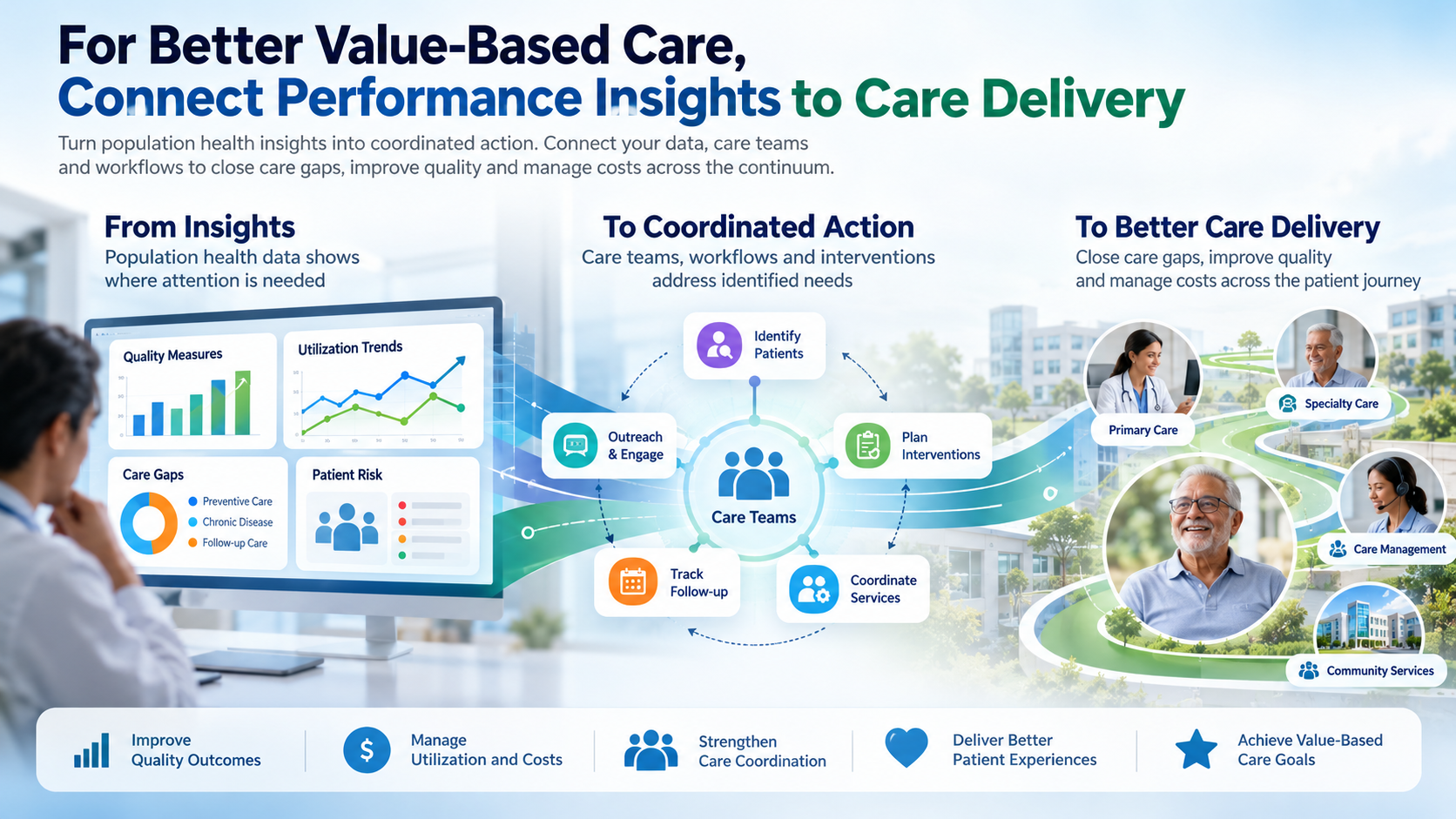
Equipo Health connects population health insights, care coordination and AI to help providers deliver more coordinated, accountable value-based care.
SOUTH PLAINFIELD, NJ, UNITED STATES, October 13, 2026 /EINPresswire.com/ — Healthcare organizations are investing in population health analytics, clinical information systems and patient engagement technology to improve care quality and manage costs. Yet having access to information does not automatically translate into better care delivery. Organizations must connect performance insights with the operational work required to address care gaps, coordinate services and maintain continuity across the patient journey.
This challenge is particularly relevant to accountable care organizations (ACOs), medical groups and other providers operating under value-based care arrangements. Their performance depends on how effectively participating organizations address patient needs, manage utilization and meet quality objectives. Achieving these goals requires a coordinated approach that connects population health insights with the teams, processes and interventions responsible for delivering care.
The Operational Challenge Behind Value-Based Care
Healthcare performance is influenced by activities that span multiple providers, care settings and patient interactions. An ACO may identify variation in quality measures across participating practices, rising utilization within its attributed population or opportunities to improve preventive care. These findings help leadership understand where attention is needed, but translating them into action requires coordination across the network.
Participating practices need to identify patients who require attention, determine appropriate interventions and track follow-up. Care management teams must organize outreach, coordinate services and maintain visibility into unresolved needs. ACO leadership, meanwhile, needs to understand whether these activities are progressing and how they relate to broader performance priorities.
When analytics, care management and referral activities operate through disconnected systems, maintaining this connection becomes difficult. Organizations may know where performance gaps exist without having a consistent view of the work underway to address them. Connecting these activities is an important step toward making performance improvement an operational process rather than a periodic exercise in reporting.
Connecting Population Health Insights With Care Delivery
Population health analytics helps organizations understand patterns across their attributed populations and participating provider organizations. Risk stratification, quality reporting and utilization analysis can help identify populations that may benefit from targeted interventions. The next step is translating these findings into practical action.
Consider an ACO that identifies variation in diabetes control across its participating practices. Analytics can help pinpoint where improvement may be needed. Participating practices can then review their patient populations, identify individuals who require additional support and coordinate appropriate interventions. These may include medication adherence support, follow-up appointments, preventive screenings or referrals to specialists. Subsequent reporting can help the organization evaluate progress against its quality objectives.
This connection between population intelligence and care delivery is central to value-based care. Analytics informs decisions about where to focus resources, while care coordination supports the activities needed to address those priorities. Without a reliable connection between the two, organizations risk identifying opportunities for improvement without establishing a consistent process for acting on them.
Maintaining Continuity Across the Patient Journey
Care delivery involves more than completing individual tasks. Patients with complex or chronic conditions may need multiple interventions over time, often involving different providers and care teams. A patient transitioning home after hospitalization, for example, may require medication reconciliation, follow-up appointments, monitoring and communication between the hospital and the primary care team.
Each activity contributes to continuity of care, but the process can become fragmented when responsibilities and information are spread across disconnected systems. Teams need visibility into previous interventions, outstanding tasks and the next steps required to support the patient.
Referral management illustrates this challenge. Initiating a referral does not guarantee that the patient receives the required service. Organizations may need to coordinate authorization, communicate with the patient, monitor appointment completion and obtain information from the receiving provider. Tracking these activities helps teams identify unresolved referrals and determine where further action is required.
A care coordination platform can help connect these responsibilities, making it easier for teams to follow the care process beyond the initial interaction. This is particularly important when patients move between care settings or rely on multiple providers to address their needs.
Supporting Multiple Care Programs Without Adding Complexity
Healthcare organizations often manage several care programs, including chronic care management, transitional care, remote patient monitoring and behavioral health. Although these programs have different clinical and operational requirements, they share activities such as patient enrollment, outreach, assessments, care planning, documentation and follow-up.
When each program relies on separate tools and processes, administrative demands can increase. Teams may have to navigate multiple applications, maintain parallel records and manually track outstanding responsibilities. This can make it harder for operational leaders to understand workloads, identify delays and allocate resources effectively.
A connected care coordination platform can provide a more consistent foundation for managing these activities. Shared patient information, task management, care plans and intervention histories help teams organize their work while supporting the specific requirements of individual programs.
For provider organizations, this is a significant consideration. They may manage complex patient populations and demanding quality requirements without the staffing or technology resources available to larger health systems. Technology that connects multiple care programs can help these organizations strengthen operational capacity while building on their existing investments.
Building a Connected Technology Foundation
Healthcare organizations have different technology environments, priorities and operational models. Some may need stronger referral coordination, while others may focus on population analytics, chronic care management or patient engagement. The objective is not necessarily to replace every existing system. It is to connect the capabilities and information needed to support coordinated care delivery.
A healthcare intelligence platform can bring together population health analytics, care management, referral coordination, patient engagement and operational reporting. When these capabilities work together, organizations can establish a clearer connection between performance priorities and the activities carried out by their teams.
Artificial intelligence can extend this foundation by helping teams extract relevant information from clinical documents, analyze patient information and reduce repetitive administrative work. Document intelligence and risk analysis can support the review of information that informs care decisions. These capabilities should complement established processes, provide useful information to care teams and preserve appropriate clinical oversight.
The value of a connected platform ultimately depends on how well it supports the organization’s operating model. Technology should help teams understand what needs attention, coordinate the appropriate response and maintain visibility into progress.
Connecting Care Coordination Capabilities at Equipo Health
Equipo’s healthcare intelligence platform brings together capabilities that support population health management, care coordination, referrals, patient engagement and AI-supported intelligence.
Compass supports care management activities, including program enrollment, task management, care planning, patient interventions and reporting. Prism provides population health analytics and visibility into risk and quality opportunities. CareLink supports referral coordination, while Contigo provides a patient-facing channel for engagement. Pulse supports provider access, and Foresight extends the platform with AI-supported document intelligence and risk analysis.
Together, these capabilities address different parts of the care delivery process. Population insights help organizations identify where attention may be needed. Care management tools support the planning and execution of interventions, while referral coordination and patient engagement help teams maintain continuity across services and interactions. Reporting supports visibility into care activities and operational progress.
For ACOs, MSOs, IPAs, FQHCs and provider organizations, this approach provides flexibility to adopt capabilities that address immediate priorities while retaining a path toward broader coordination. The focus is on connecting the work of care delivery rather than treating analytics, care management and patient engagement as isolated functions.
Preparing for the Next Stage of Value-Based Care
As value-based care evolves, healthcare organizations must connect accountability for performance with the operational processes that influence it. Identifying care gaps, monitoring utilization and measuring quality are essential, but these activities need to inform coordinated action across participating organizations and care teams.
For healthcare leaders evaluating care coordination technology, the key consideration is how effectively a platform connects these responsibilities. Patient identification, task automation and reporting each serve a purpose, but their broader value depends on how well they support care planning, intervention delivery, referral follow-up and continued visibility across care programs.
Better value-based care requires a reliable connection between understanding where improvement is needed and coordinating the work required to achieve it. Care coordination should therefore be considered a core part of healthcare technology strategy, helping organizations translate performance insights into consistent care delivery and more accountable operations.
About Equipo Health’s Platform
Equipo Health’s Unified Healthcare Intelligence Platform connects population health analytics, care management, referral coordination, patient engagement and AI-supported intelligence to help healthcare organizations turn insights into coordinated care delivery.
The platform got featured in 2026 KLAS Research’s Emerging Company Spotlight for Centralized Care Management & Referrals with Customizable Workflow Automation.
Equipo Ecosystem includes Compass for care management, Prism for population health analytics, CareLink for referral coordination, Contigo for patient engagement, Pulse for provider access and Foresight as the AI Ecosystem. These capabilities support ACOs, MSOs, IPAs, FQHCs and other healthcare organizations in connecting performance insights with the work of coordinating care.
Prince Mamman
Connect Care
+1 732-221-1050
Visit us on social media:
LinkedIn
Instagram
X
Legal Disclaimer:
EIN Presswire provides this news content “as is” without warranty of any kind. We do not accept any responsibility or liability
for the accuracy, content, images, videos, licenses, completeness, legality, or reliability of the information contained in this
article. If you have any complaints or copyright issues related to this article, kindly contact the author above.

Media gallery