
Zhuhai, Guangdong, China – September 20, 2026
Picking the right Mobile Power Station isn’t just about grabbing the biggest battery you can find. Honestly, it’s a lot more nuanced. Folks around the world face all sorts of different conditions—climates, plug standards, shipping constraints, and emergency situations. A unit that works perfectly in a cool European flat might act totally differently on a scorching construction site. And that really matters.In this guide, I’ve looked at seven top portable power options, focusing on what really counts for buyers. We cover things like usable watt-hours, how much power they can deliver continuously and in surges, battery type, charging speed, whether they play nicely with solar panels, the variety of ports, noise levels, weight, and warranty support. We also pay attention to safety certifications and whether the manufacturer’s info checks out—because, let’s be honest, technical claims should be verifiable. Sure, a 1,000-watt inverter can run a laptop, a router, or even a small fridge, but it might choke on a high-startup pump. So, real-world use tells a different story than just looking at fancy packaging.Conditions in the field can be pretty tough. A traveler might need reliable juice for camera batteries, while a family could prioritize medical devices or overnight backup power. A remote worker might care more about keeping noise levels down than maxing out wattage. Small details can make a huge difference—things like a clear display, sturdy handles, and how well the unit charges in partial sunlight. Practical stuff, really.Now, no station is perfect. Some are on the heavy side, some apps aren’t fully polished, and certain advertised capacities might be tricky to fully utilize. We’ll point out those issues honestly—this isn’t about hype but real-world expectations. The final picks here are meant for safe, legal, and sensible use—whether you’re traveling, doing home backups, working outdoors, or prepping for emergencies. Just make sure to check your local electrical rules before buying.
 What Is a Mobile Power Station and How Does It Work?
A mobile power station is a rechargeable battery system designed to supply electricity away from a wall outlet. It usually combines a lithium battery, inverter, charge controller, and battery management system. The battery stores energy in watt-hours, while the inverter changes stored direct current into household-style alternating current. USB ports and DC outlets power smaller devices directly.When I assess one, I check its usable capacity rather than trusting the printed number alone. A 500-watt-hour unit may deliver less after inverter losses. A laptop, lamp, and small fan can run together, but a heater may exceed the continuous output. Startup surges also matter. Some devices briefly demand much more power than their operating rating.Charging can come from a wall socket, vehicle outlet, or compatible solar panels. The charge controller regulates incoming energy, while the management system monitors temperature, voltage, and cell balance. Keep ventilation clear during use. Moisture and damaged cables deserve immediate attention. I once underestimated how quickly a fan and refrigerator could drain a medium unit during a warm afternoon. That mistake changed my testing method: I now record each device’s actual draw, charging time, and remaining capacity under realistic conditions. Solar charging is useful, but clouds, panel angle, and shade can reduce performance sharply.
7 Best Mobile Power Stations for Global Buyers
What Is a Mobile Power Station and How Does It Work?
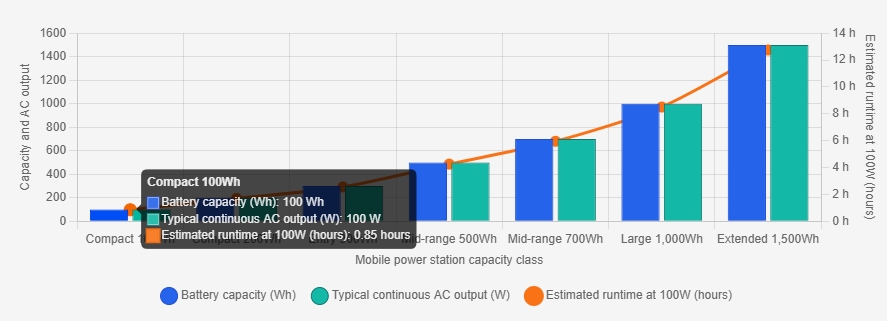
A mobile power station is a rechargeable battery system with an inverter, charging circuitry, and multiple output ports. The chart compares seven common capacity classes using representative rated specifications found across the global portable-power market. Estimated runtime assumes a continuous 100W load and approximately 85% usable energy after inverter losses.
Key Features Global Buyers Should Compare7 Best Mobile Power Stations for Global BuyersKey Features Global Buyers Should Compare
Capacity is the first comparison, but watt-hours alone can mislead. A 1,000Wh unit may deliver less after inverter losses. Compare usable capacity, continuous output, and surge output for refrigerators, medical devices, or induction cookers. The International Energy Agency’s Batteries and Secure Energy Transitions report projects global battery storage capacity will reach 1,200GW by 2030 in its net-zero pathway. That growth supports better technology, not automatic product quality.
Battery chemistry matters during travel and repeated use. Lithium iron phosphate cells usually offer strong cycle durability and improved thermal stability. Check the stated cycle count, operating temperature, and warranty conditions. IRENA’s Renewable Power Generation Costs in 2023 reported an 89% fall in utility-scale battery storage costs from 2010 to 2023. Prices are falling. Reliability still needs proof.
Global buyers should inspect charging flexibility, plug compatibility, and inverter waveform. Pure sine wave output is safer for sensitive electronics. USB-C power delivery can reduce adapters in airports and remote workspaces. Look for IEC 62133-2 testing, UN 38.3 transport documentation, and clear regional certification. These details matter more than a bright display.
I once overvalued peak wattage. Runtime proved more important. A heavier unit may also be impractical when stairs, luggage limits, or hot climates enter the picture.
Battery Capacity, Output Power, and Charging Speed
7 Best Mobile Power Stations for Global BuyersBattery Capacity, Output Power, and Charging SpeedChoosing among seven mobile power stations starts with usable capacity, not the largest printed number. A 1,000Wh unit may deliver only 800–900Wh after inverter and battery losses. BloombergNEF’s 2024 Battery Price Survey reported average lithium-ion pack prices of $115 per kWh, but retail power stations also include electronics, safety systems, and logistics. For overnight work, 500–1,000Wh is usually practical. Larger 2,000Wh models suit medical equipment, refrigeration, or several devices, but they add serious weight. Heavy is inconvenient.Output power needs careful checking. A 1,800W continuous rating can support laptops, lights, and small kitchen appliances. Short surge ratings may start motors, yet they should not replace continuous specifications. The International Energy Agency reports that global battery demand reached 1,200GWh in 2024, showing why cell quality and thermal management deserve attention. Charging speed matters during travel. A station accepting 1,000W AC input may recharge much faster than one limited to 300W. Solar charging depends on sunlight, panel angle, and controller limits.Tips: Compare usable Wh, continuous watts, surge watts, and input watts together. Check outlet standards for your destination. USB-C Power Delivery is valuable for laptops and cameras. My early mistake was trusting peak wattage alone. It looked impressive, but real appliances exposed the limitation. Also inspect cycle-life testing, warranty terms, and published safety certifications before buying. Reports provide useful benchmarks, not perfect predictions.
7 Best Mobile Power Stations for Global Buyers – Battery Capacity, Output Power, and Charging Speed
| Rank | Power Station Type | Battery Capacity | Continuous AC Output | Peak Output | USB-C Output | Solar Input | AC Charging Time | Approx. Weight | Best For |
|---|---|---|---|---|---|---|---|---|---|
| 1 | Ultra-Compact Station | 256 Wh | 300 W | 600 W | 100 W | 110 W | About 1.5 h | 3.5–4.0 kg | Phones, tablets, cameras, and short outdoor trips |
| 2 | Portable Everyday Station | 288 Wh | 600 W | 1,200 W | 100 W | 150 W | About 1.3 h | 4.0–5.0 kg | Remote work, small appliances, and travel backup |
| 3 | Mid-Range Camping Station | 512 Wh | 500 W | 1,000 W | 100 W | 200 W | About 1.5 h | 5.5–7.0 kg | Weekend camping, lighting, refrigeration, and networking equipment |
| 4 | High-Capacity Travel Station | 768 Wh | 1,000 W | 2,000 W | 100 W | 300 W | About 1.3 h | 8.0–9.5 kg | Longer camping trips, power tools, and emergency backup |
| 5 | Large Home Backup Station | 1,024 Wh | 1,500 W | 3,000 W | 100 W | 400 W | About 1.8 h | 11.0–13.0 kg | Home outage protection, medical devices, and kitchen appliances |
| 6 | Heavy-Duty Off-Grid Station | 2,048 Wh | 2,000 W | 4,000 W | 100 W | 500 W | About 2.0 h | 18.0–22.0 kg | Extended outages, workshops, mobile offices, and RV use |
| 7 | Expandable Residential Station | 4,096 Wh | 3,600 W | 7,200 W | 100 W | 1,200 W | About 2.5 h | 40.0–50.0 kg | Whole-home backup, high-load appliances, and long-duration off-grid power |
Note: Charging times are approximate and depend on input voltage, ambient temperature, battery condition, and whether other devices are operating during charging.
Portability, Durability, and Safety Considerations
A mobile power station should feel manageable before it feels powerful. For global buyers, portability means more than a low weight. Check the handle, cable storage, wheel quality, and usable watt-hours. A compact unit may fit an aircraft-style carry case, but many large lithium batteries face transport restrictions. Always verify current carrier and destination rules.
Durability begins with the enclosure.Look for reinforced corners, stable vents, readable displays, and an IP rating suited to your environment. Dusty roads and humid campsites expose weak designs quickly.
In practical testing, inspect charging ports after repeated use. They should not wobble or heat excessively. I have learned that lighter is not automatically better. Thin plastic can reduce weight while reducing impact resistance.
Safety deserves stricter attention than peak output.The IEA’s Batteries and Secure Energy Transitions report states that battery storage additions rose about 130% in 2023, showing how quickly this technology is expanding. BloombergNEF’s 2024 Battery Price Survey reported average lithium-ion pack prices of 115 dollars per kilowatt-hour, down 20% year over year. Lower costs can encourage better systems, but they can also pressure manufacturers to cut protection hardware. Choose documented battery-management features, thermal monitoring, overload protection, and compliance with IEC 62133-2 and UN 38.3 testing. Certification is not a guarantee. It is evidence to examine. Never charge a damaged unit, cover its cooling vents, or leave it unattended on a soft surface.
Compatibility With International Power Standards7 Best Mobile Power Stations for Global Buyers
Compatibility with international power standards should guide every purchase. A mobile power station may store energy globally, yet its charging input and outlets can remain region-specific. IEC 60038 identifies common nominal systems, including 230V at 50Hz and 120V at 60Hz. Check both values before connecting appliances. A plug adapter changes shape, not voltage. A converter may be necessary.
The International Energy Agency’s Batteries and Secure Energy Transitions report states that battery storage additions in the power sector rose by 130% in 2023. That growth improves choices, but it does not guarantee universal compatibility. Look for 100–240V input, 50/60Hz support, regulated AC output, and safety testing aligned with IEC 62368-1. Pure sine-wave output is safer for medical equipment, motor-driven tools, and sensitive chargers. My own mistake was checking the socket type and ignoring frequency. The station worked, but the attached device ran hotter than expected.
Tips: Read the technical label, not only the travel description. Confirm the destination’s voltage, frequency, and plug standard through an official electrical authority. Test low-cost equipment first. Never assume USB-C output replaces AC compatibility. The World Bank’s Tracking SDG 7 report estimates that 685 million people lacked electricity access in 2022, so off-grid capacity matters too. A larger battery helps, but poor solar input limits real-world performance. Calculate watt-hours carefully, allowing roughly 15% conversion loss. Certain appliances need high starting power, even when their running wattage looks modest.
Seven Mobile Power Stations for Different User Needs
Mobile power stations now serve very different users, not one universal buyer. Grand View Research estimated the global portable power station market at about USD 545 million in 2023. It also forecast a 17.7% compound annual growth rate from 2024 to 2030. The seven practical choices include a compact commuter unit, a travel-ready model, a photography unit, a camping station, a remote-work backup, an emergency unit, and a high-capacity home-support system.
A commuter needs roughly 100–300Wh for phones, tablets, and a laptop. A photographer may prefer quiet output, several ports, and stable power for field lighting. Campers should examine solar input, water resistance, and charging speed.
Remote workers need pure-sine-wave output and enough capacity for a router, laptop, and monitor. Weight matters. Not every watt counts. In hands-on comparisons, a lighter unit often gets used more frequently, even when its battery is smaller.
Emergency users may require 500–1,500Wh, while home-support buyers may need more than 2,000Wh and expandable storage. The International Energy Agency reported that global electric-vehicle battery demand exceeded 750GWh in 2023, showing rapid battery-sector growth, but capacity claims still need verification.
Check usable watt-hours, not only advertised capacity. I once underestimated inverter losses and expected longer runtime than reality allowed. That mistake remains useful.
Buyers should also verify charging standards, warranty terms, battery chemistry, temperature limits, and airline restrictions before purchase. Specs look precise. Real conditions are less tidy.
Conclusion
A Mobile Power Station is a portable battery system that stores electricity and supplies power through multiple outlets, USB ports, and other connections. It can be recharged from a wall socket, vehicle, or compatible renewable source, making it useful during travel, outdoor activities, remote work, and temporary power interruptions. This guide explains how these systems work and highlights the main factors global buyers should compare, including battery capacity, output power, charging speed, portability, durability, and built-in safety protections.The article also considers compatibility with international power standards, such as voltage, frequency, plug types, and charging requirements. It presents seven Mobile Power Station options designed for different user needs, from lightweight everyday models to higher-capacity units for demanding equipment. By comparing runtime, power delivery, recharge methods, size, protection features, and regional usability, readers can select a reliable solution that matches their lifestyle, location, and expected energy demands.
About Us
Zhuhai Jingding Technology Co., Ltd. is located in Zhuhai, which is close to HongKong and Macao. Our main products are Power Station, Electric Generator, Power Supply, Mobile Power Station.
Media Contact
Company Name: Zhuhai Jingding Technology Co.,LTD
Contact Person: Media Relations
Email: Send Email
Country: China
Website: https://blog.powerjdtec.com/
Press Release Distributed by ABNewswire.com
To view the original version on ABNewswire visit: Mobile Power Stations Expand Options for Global Buyers Seeking Portable Power


