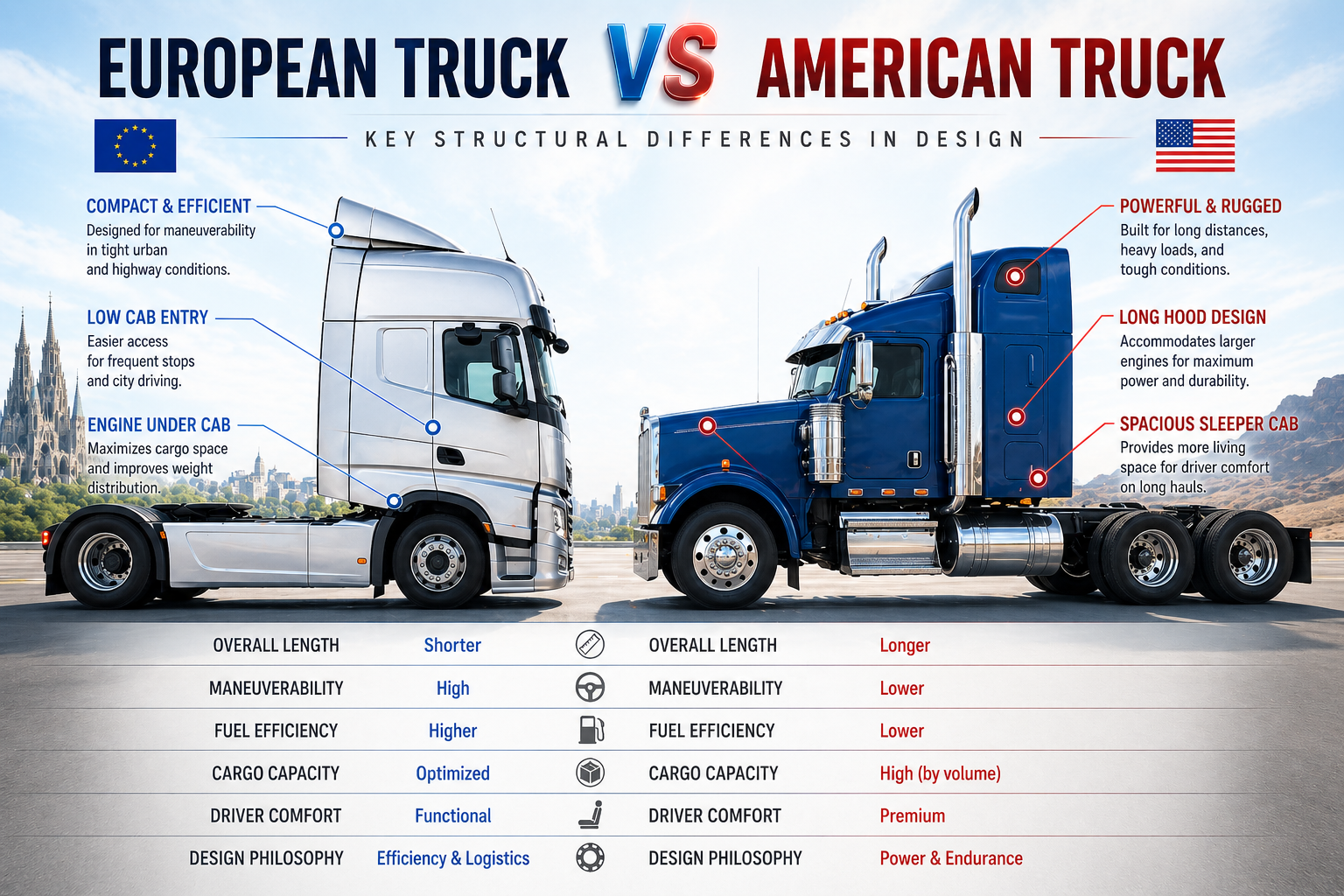
CHICAGO, IL, UNITED STATES, April 30, 2026 /EINPresswire.com/ — American and European trucks do the same job, but they were shaped by very different rules and operating environments. In the European Union, the standard framework has long been built around compact dimensions: roughly 16.5 meters for articulated vehicles, 18.75 meters for road trains, and generally 40 tonnes gross weight, rising to 44 tonnes in some intermodal cases. In the United States, by contrast, federal rules on the National Network require states to allow at least a 48-foot semitrailer, generally permit 102-inch (2.6 m) width, and do not impose an overall length limit on a tractor pulling a single semitrailer; the widely recognized federal interstate gross vehicle weight benchmark is 80,000 pounds (about 36.3 tonnes). Those numbers alone explain much of the visual contrast between the two truck types.
That difference is not cosmetic. It affects the whole truck. In Europe, where total vehicle dimensions are tightly managed, manufacturers have favored the cab-over-engine layout because it saves length and leaves more room for cargo within the legal envelope. In the U.S., where the law is more permissive about tractor length in a tractor-semitrailer combination, the conventional long-nose truck became the dominant format. Europe effectively rewards compactness; America leaves more room for the tractor itself.
The road environment reinforces that split. European trucks must work across older cities, narrower streets, tighter roundabouts, and denser cross-border networks. American trucks operate in a system built around long interstate corridors and wide highway geometry. That helps explain why European tractors tend to look shorter and more vertical, while American trucks often have longer wheelbases and larger hoods. Neither solution is inherently better; each is optimized for the network it serves.
Cab size tells a second story: not just engineering, but driver life. U.S. hours-of-service rules generally allow a property-carrying driver to drive up to 11 hours after 10 consecutive hours off duty, within a 14-hour on-duty window. EU rules are stricter on daily driving: the normal limit is 9 hours per day, extendable to 10 hours only twice a week, with a 56-hour weekly cap and 90 hours over two weeks. Those frameworks do not fully define how trucks are built, but they do help explain why the American sleeper cab evolved into a larger living space, while many European cabs remained more compact and operationally focused.
Maintenance philosophy also differs. On a European cab-over truck, engine access often requires tilting the cab. That supports compact design but can be less convenient for service. On a conventional American truck, the engine sits under a hood, which simplifies access for maintenance and repairs. This is one reason the long-nose configuration remained practical in the U.S., especially for fleets covering long distances where serviceability matters.
There is also a scale factor. In 2024, total road freight transport in the EU reached 1,869 billion tonne-kilometres, and Poland alone accounted for 368 billion tonne-kilometres, nearly 20% of the EU total. In the United States, the freight system is broader and more distance-driven: BTS reports that in 2023 the country moved an average of about 55.5 million tons of freight per day, or about 20.2 billion tons annually across all modes. The markets are different in structure, but both are enormous—and both reward trucks built for their own geography and rules.
A useful irony is that the two systems are not completely different. In width, they are actually quite close: U.S. federal width rules are effectively 2.6 meters, and EU maximum width is commonly referenced at about 2.6 meters in policy summaries tied to the Weights and Dimensions Directive. The major divergence is not width but how length is distributed: Europe compresses the tractor to protect cargo capacity within overall limits, while the U.S. allows a physically larger tractor ahead of the trailer.
The cultural result is easy to recognize. European trucks are often designed as highly efficient freight tools first. American trucks, while equally commercial, developed a stronger identity around long-haul endurance, larger sleeper accommodations, and driver presence. That image is reinforced by the fact that the U.S. fleet is vast: BTS noted that 2.9 million truck tractors in the country traveled an average of about 48,500 miles in 2021, a reminder of how central the long-haul tractor remains in American freight.
In the end, American and European trucks look different because they solve different transport problems. Europe prioritizes compactness, maneuverability, and maximizing freight within strict dimensional rules. The United States prioritizes highway comfort, service access, and flexibility in tractor design. Same job, different design logic. And once the legal and geographic context is clear, the trucks stop looking unusual—they start looking inevitable.
Artur Gronus
Cargoos Logistics
+1 312-772-4422
email us here
Visit us on social media:
LinkedIn
Facebook
X
Legal Disclaimer:
EIN Presswire provides this news content “as is” without warranty of any kind. We do not accept any responsibility or liability
for the accuracy, content, images, videos, licenses, completeness, legality, or reliability of the information contained in this
article. If you have any complaints or copyright issues related to this article, kindly contact the author above.

Media gallery