An NVIDIA CUDA-Q program compiled for the OPX1000 can now run real-time, mid-circuit decoding in microseconds on accelerated computing via NVIDIA NVQLink
CHICAGO, IL, UNITED STATES, November 16, 2026 /EINPresswire.com/ — Quantum Machines (QM) today announced first results running NVIDIA CUDA-Q QEC decoders (classical software that reads a quantum computer’s error-check results and decides how to correct them) on the OPX1000 quantum control system through the Realtime API in the NVIDIA CUDA-Q platform – allowing microsecond-latency callbacks between quantum controllers and classical processors, and NVIDIA NVQLink. OPX1000 customers will be able to run CUDA-Q QEC decoders, or their own, through the CUDA-Q decoding server.
“Error correction only works if decoding can keep pace with the quantum hardware. With the OPX1000 connecting to NVIDIA decoders seamlessly over NVQLink, we have brought state-of-the-art decoding closer to every quantum computer using our platform,” said Yonatan Cohen, co-founder and CTO of Quantum Machines.
CUDA-Q Realtime gives developers a runtime API for microsecond-latency callbacks between quantum controllers and classical compute: the controller sends a request, a dispatcher routes it to a registered handler, and the response goes back. Handlers run on host CPU or GPU threads, and because dispatch is separate from the transport, any control system can connect by implementing a bridge.
The CUDA-Q QEC decoding server builds upon CUDA-Q by registering decoders as handlers. The decoding server is transport-agnostic, containing no networking code. The same QEC software stack, configuration format and decoder setup carry over unchanged when the transport layer changes.
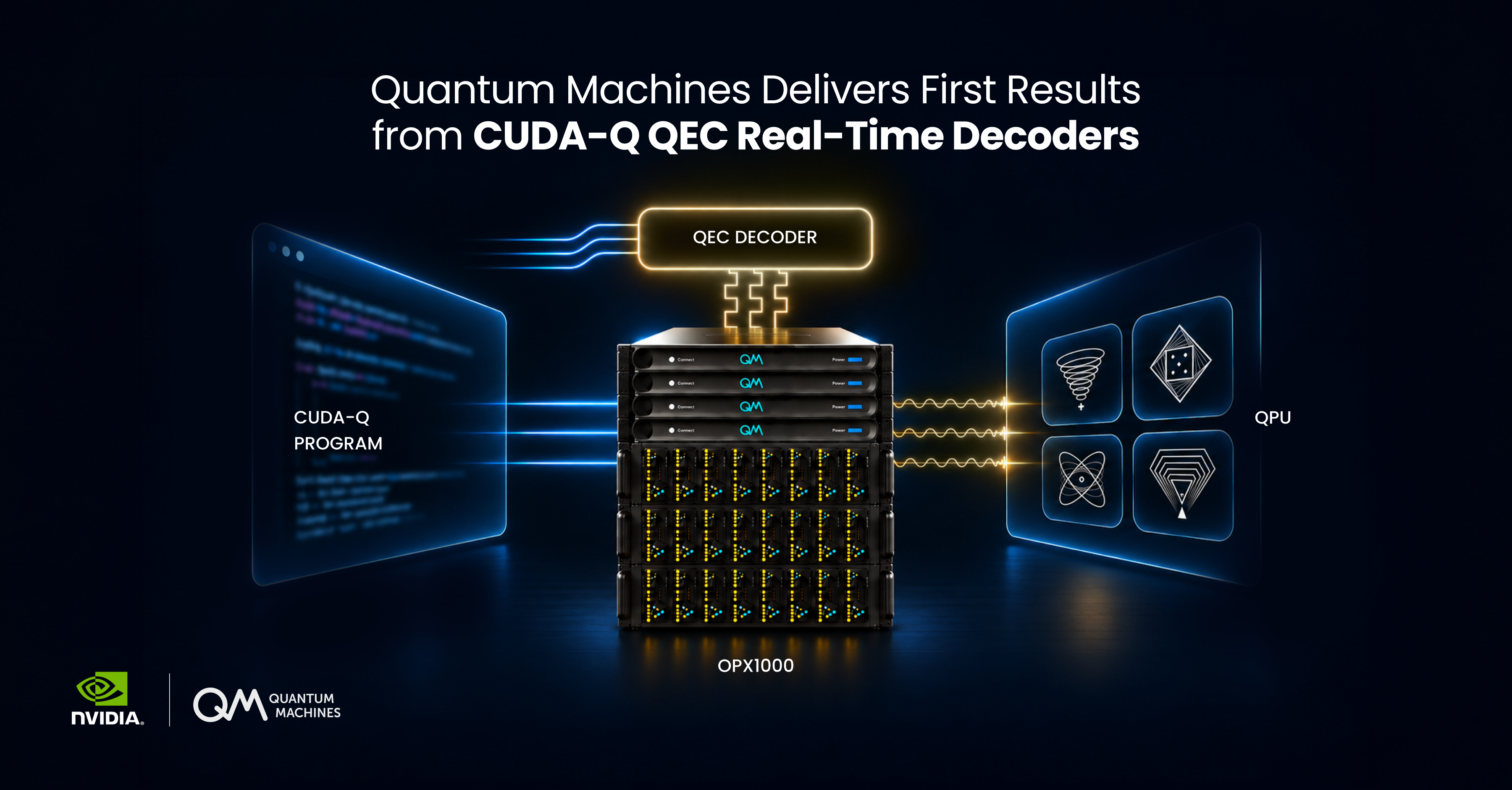
QM implemented the CUDA-Q Realtime bridge for its OPX1000 control system (Figure 1), giving the error-check measurements (syndromes) a microsecond-latency path to the decoder and a path back for the corrections. A quantum program written in CUDA-Q is compiled once and runs as a single job on the OPX1000. Syndromes travel to the decoder and the correction travels back over the same NVQLink path. This early implementation uses the CPU dispatch path, in which syndrome data passes through the host CPU, with GPU dispatch coming next. It supports static memory circuits (circuits that store a logical qubit without running logic operations) written in CUDA-Q and compiled through Quake to QUA.
“Getting new error-correction methods into working quantum systems is a critical step toward fault tolerance,” said Sam Stanwyck, Director of Quantum Product at NVIDIA. “Quantum Machines’ integration with NVIDIA CUDA-Q gives developers a common path to experiment with different decoders through the same control system, helping them move more quickly from algorithm research to real-time testing.”
To show the flow end to end, we ran a single CUDA-Q program on the OPX1000 that performs a surface-code memory experiment with real-time decoding (Figure 1). The program was compiled once and executed 10,000 shots for each of nine configurations: code distances 7, 11 and 15, each at 25, 50 and 75 rounds of error correction, using pre-sampled syndromes at a 0.1% physical error rate.
In every shot, the controller sent its syndromes to the NVIDIA GH200 over NVQLink, where the PyMatching decoder decoded them and returned the correction. Decoding happens during the experiment rather than as a separate step afterwards. The results show a steady 2.4 μs two-way communication latency between the controller and the decoder across all configurations. Decoding latency per round is 0.19–0.22 μs at distance 7 and 0.56–0.67 μs at distance 11, comfortably below 1 μs, the figure we treat as the mark for keeping pace with a fast QEC cycle. At distance 15 it is 1.2–1.5 μs, which is where further optimization will matter most.
Users decide how to decode. Because the decoder is a handler behind the device calls, they can pick one of NVIDIA’s decoders, such as PyMatching or the NVIDIA fusion decoder, by changing one line of configuration, writing their own, or using the same path for any other classical-to-quantum control task.
This is an early implementation, available for customer installation in December 2026.
About Quantum Machines
Quantum Machines (QM) is the leading global provider of hybrid quantum-classical control solutions. Its Hybrid Control approach harmonizes quantum and classical operations across software and hardware, helping teams iterate faster and resolve setbacks. QM’s Orchestration Platform delivers Hybrid Control in one environment for systems from a few qubits to thousands, with solutions tailored to each modality. QM empowers researchers and builders to iterate at speed, resolve setbacks, and scale systems previously thought impossible. Learn more at: Quantum Machines
Media contact: Katia Moskvitch, katia.moskvitch@quantum-machines.co
Gerry Wisniewski
Catchfire PR Ltd
gerrywiz@catchfire.co
Legal Disclaimer:
EIN Presswire provides this news content “as is” without warranty of any kind. We do not accept any responsibility or liability
for the accuracy, content, images, videos, licenses, completeness, legality, or reliability of the information contained in this
article. If you have any complaints or copyright issues related to this article, kindly contact the author above.

Media gallery