Hadron Energy, Inc. (Nasdaq: HDRN) (“Hadron Energy” or the “Company”), developer of the Halo Micro-Modular Reactor (“MMR”), today announced that it has selected GSE Performance Solutions, LLC. (dba “GSE Solutions” or “GSE”), a global leader in nuclear plant training simulation, as its supplier for the design, development, delivery, installation, and commissioning of a full-scope, high-fidelity training simulator for the Halo MMR. The selection advances the companies’ relationship into a committed strategic alliance, establishes the cornerstone of Hadron Energy’s operator readiness strategy, and marks a critical milestone on the Company’s path to commercialization: producing the NRC-licensed operating staff the Halo MMR must have in place before it can be brought to criticality and commercial power.
This press release features multimedia. View the full release here: https://www.businesswire.com/news/home/20260609236153/en/
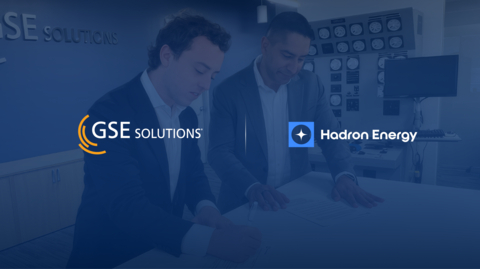
Hadron Energy Founder & CEO Sam Gibson (left) and GSE Solutions President & CEO Ravi Khanna formalize the companies’ simulator alliance at GSE Solutions headquarters
Under the alliance, GSE will lead the end-to-end development and commissioning of a plant-specific simulator that replicates the full range of the Halo MMR’s expected operating behavior, encompassing normal power operations, anticipated operational occurrences, design-basis events, and beyond-design-basis scenarios. The simulator will serve as the principal training platform for reactor operators, senior reactor operators, shift technical advisors, and engineering staff across Hadron Energy’s First-of-a-Kind (“FOAK”) deployment, with provisions to extend the engagement to support subsequent commercial units as the Company scales toward repeatable delivery. Formalizing GSE’s scope moves one of the longest-lead, licensing-critical elements of the Halo MMR program from framework to execution, consistent with the Company’s broader strategy of converting early-stage agreements into committed delivery partners ahead of commercialization.
Why a Simulator Is the Precondition for Operation
Every operating commercial nuclear plant in the United States is controlled by individually licensed operators whose authority to manipulate the plant’s controls comes directly from the U.S. Nuclear Regulatory Commission, and the path to that license runs through a single piece of equipment: the plant-referenced training simulator.
NRC regulations require every candidate Reactor Operator and Senior Reactor Operator to complete structured training and pass written, operational, and simulator-based examinations administered on a simulator that accurately models the facility they will operate (10 CFR Part 55). The training simulator is not an instructional enhancement layered on top of an otherwise complete reactor, it is a regulatory prerequisite for the authorization to generate a single megawatt-hour of commercial electricity.
The importance of the simulator extends well beyond exam administration. It is the environment in which operating crews develop the situational awareness, procedural fluency, diagnostic instincts, and crew-resource-management reflexes that separate a plant that runs dependably from one that does not. The same logic that keeps commercial aviation safe, that pilots learn to handle emergencies in a simulator rather than in the cockpit, governs nuclear operator training for the same reason: the cost of learning in the real plant is unacceptable, and the only substitute that produces equivalent competence is a simulator to respond exactly as the plant would.
The simulator is also a system-level engineering instrument. It is the environment in which normal, abnormal, and emergency operating procedures are validated, in which human-factors engineering is verified against the actual behavior of the plant, and in which plant-specific upsets are walked through repeatedly before fuel is ever loaded. Commissioning a simulator early in the Hadron Energy development process allows the simulator and its findings to inform the design itself, surfacing operability concerns while the design can still accommodate them rather than after the concrete is poured.
Why GSE
GSE and its predecessor organizations have been at the center of nuclear training simulation since the company built one of the first commercial full-scope nuclear power plant simulators in 1971. The decades of work that followed have produced a globally deployed installed base spanning pressurized water reactors, boiling water reactors, CANDU units, VVER designs, and a growing set of small modular and advanced reactor programs. GSE’s experience is an accumulation of modeling methodology, simulator-engineering craft, and regulatory interaction that no recent entrant to the market can replicate.
For an advanced reactor program like the Halo MMR, that experience translates into two practical advantages. GSE brings mature thermal-hydraulic, neutronics, control-system, and balance-of-plant modeling frameworks that have already been exercised against decades of operating-plant data, materially reducing the development risk inherent in any FOAK simulator build. GSE’s engineering teams have also supported simulator certification activities across the U.S. utility fleet, institutional experience that translates directly into a cleaner path to a simulator that meets ANSI/ANS-3.5 standards and earns regulatory acceptance.
“You cannot commission a nuclear plant without certified operators, and you cannot certify operators without a high-fidelity simulator that represents the plant they are going to operate. GSE has been building that environment for the industry for more than fifty years. Bringing them in at this design stage for the Halo MMR, lets us replicate the plant virtually as we are designing it. This sharpens the design and surfaces any operability or human-factors issues while the engineering is still flexible enough to address them. That is how a reactor program reaches operational readiness on schedule and with confidence.”
— Ross Ridenoure, Chief Nuclear Officer, Hadron Energy
Sequenced Alongside the Rest of the Program
The GSE selection builds on Hadron Energy’s recent partnership with Paragon Energy Solutions, a Mirion Technologies Company, on the instrumentation and control architecture for the Halo MMR, the same I&C design the simulator will need to replicate for operator training. Developing the simulator in parallel with the plant, rather than after it, reduces the likelihood of discovering late in the schedule that the two have drifted apart, and positions Hadron Energy to begin operator training well in advance of fuel load so that the first crew of NRC-licensed operators is ready on the day the Halo MMR is.
“Every engineering decision on the Halo MMR is aimed at the same question: how do we take proven nuclear technology and move it from drawing to operating as efficiently as possible while meeting every safety and regulatory standard that governs this industry? The simulator is a central part of that answer, because an advanced reactor without trained, licensed operators is not a power plant, it is an asset sitting idle. GSE has done this work for utilities around the world for more than fifty years. We are putting that experience directly at the center of our operator readiness strategy from the beginning. Establishing this partnership with GSE, as a newly public company, is exactly the kind of disciplined, sequenced execution our shareholders and future customers should expect from us between now and first power.”
— Sam Gibson, Founder and Chief Executive Officer, Hadron Energy
“We are honored that Hadron Energy has selected GSE Solutions as its strategic simulation partner for the Halo Micro-Modular Reactor program. For decades, GSE experts have connected generations of project knowledge to help the nuclear industry prepare operators for the safe, reliable, and efficient operation of complex facilities. Our high-fidelity simulation technology and engineering expertise allow developers to validate designs, refine operating strategies, and build the licensed workforce needed to achieve commercial operation. As advanced nuclear technology moves from concept to deployment, partnerships like this will play an essential role in ensuring these innovative technologies are brought online safely, efficiently, and with confidence.”
— Ravi Khanna, President & Chief Executive Officer, GSE Solutions
About Hadron Energy, Inc.
Hadron Energy is a pioneer in MMR technology. Designed to deliver 10 MWe of continuous power, the Halo MMR is smaller, more cost-effective, and faster to deploy than other proposed nuclear power solutions. The reactor’s vessel, core, and containment shell are fully truck-transportable, enabling deployment across AI data centers, industrial hubs, remote communities, and infrastructure facilities where traditional power solutions cannot deliver. Hadron Energy is advancing the Halo MMR through an integrated program of technical development, NRC licensing engagement, and a growing portfolio of strategic supply chain and deployment partnerships. On May 22, 2026, Hadron Energy completed its business combination with GigCapital7 Corp. and became on May 26, 2026 the first publicly traded light-water micro-modular nuclear reactor company; its common stock and warrants trade on the Nasdaq Stock Market under the ticker symbols “HDRN” and “HDRNW,” respectively. For more information, please visit www.hadronenergy.com.
About GSE Solutions
At GSE, performance drives everything we do. We support nuclear power and clean-energy fleets worldwide through integrated engineering software and services that strengthen operations and improve results. Spanning high-fidelity simulation, design engineering, thermal performance, and engineering programs, our proven experts combine deep nuclear expertise, legacy project knowledge, and modern best practices to help customers operate safer, leaner, and more profitably. Since delivering one of the industry’s first commercial full-scope nuclear power plant simulators in 1971, GSE has remained a trusted provider of simulation for nuclear operators worldwide. For more information, visit www.gses.com.
Forward-Looking Statements
This press release contains forward-looking statements within the meaning of U.S. federal securities laws, including, but not limited to, statements regarding the anticipated scope, schedule, and benefits of the simulator program with GSE, the Company’s operator training and licensing strategy, and the development, licensing, and commercialization of the Halo MMR. Any statements contained herein that are not statements of historical fact may be deemed to be forward-looking statements. The words “anticipate,” “believe,” “continue,” “could,” “estimate,” “expect,” “intends,” “may,” “might,” “plan,” “possible,” “potential,” “predict,” “project,” “should,” “would” and similar expressions may identify forward-looking statements, but the absence of these words does not mean that a statement is not forward-looking. These forward-looking statements are based on certain assumptions and analyses made by the management of Hadron Energy in light of their experience and perception of historical trends, current conditions, and expected future developments, as well as other factors they believe are appropriate in the circumstances, and involve a number of risks and uncertainties, some of which are beyond the Company’s control, that may cause actual results or performance to be materially different from those expressed or implied by these forward-looking statements. Should one or more of these risks or uncertainties materialize, or should any of the assumptions being made prove incorrect, actual results may vary in material respects from those projected in these forward-looking statements. The Company undertakes no obligation to update or revise any forward-looking statements, whether as a result of new information, future events or otherwise, except as may be required under applicable securities laws.
View source version on businesswire.com: https://www.businesswire.com/news/home/20260609236153/en/
Media gallery
